A soggy yard or a damp basement smell occurs every time it rains. You’ve probably run into two terms that sound alike: French drain and footing drain. They’re not the same and mixing them up means paying for a fix that doesn’t fix anything. Here’s the French drain vs footing drain Connecticut breakdown you need.
What Is the Main Difference Between French Drain and Footing Drain?
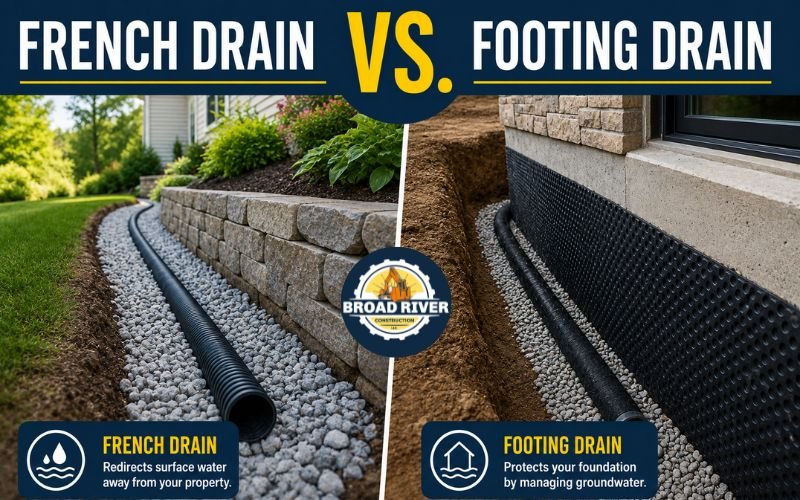
Both use the same basic parts: a trench, a perforated pipe and gravel. Buried in the ground, they look the same. What’s different is where each sits and the job it does.
| Feature | French Drain | Footing Drain |
| Main job | Moves water away from a yard or low spot | Protects the foundation from groundwater pressure |
| Typical depth | 1–3 feet | 4–8 feet, at the foundation base |
| Best for | Soggy lawns, surface runoff | Wet basements, foundation seepage |
| Location | Anywhere in the yard | Around the foundation perimeter |
Think of it this way: a French drain handles water sitting in the yard, while a footing drain handles water already pressed against the foundation wall. If your basement’s flooding but the yard looks fine, you need something at the footing.
What Is a French Drain and When Do You Need One?
A French drain is pretty simple: dig a trench, drop in a perforated pipe and fill with gravel. Water collects before it pools, then gets carried off somewhere safer, a dry well, the street, wherever makes sense. Since it only goes one to three feet down, French drain installation in CT yards tends to be quick.
You’d want one if:
- Rainwater keeps collecting in the same spot.
- A slope sends runoff toward your house.
- Downspouts dump water too close to the foundation.
Signs Your CT Property Needs a French Drain
Connecticut’s springs are wet and fall rain hits hard. Yard drainage Connecticut homeowners deal with often gets ignored until it’s a real problem:
- Standing water that’s still there a day later.
- Mosquitoes showing up in the same spot repeatedly.
- Bare patches or erosion where water keeps cutting through.
If it’s staying outside, away from the walls, a French drain is probably enough.
What Is a Footing Drain and When Do You Need One?
This one sits lower, right at the foundation base. It catches groundwater before it builds enough pressure to push through the wall. That pressure has a name: hydrostatic pressure, behind that musty smell nobody can get rid of.
Because it sits so deep, footing drain installation handled by CT crews is a bigger dig, usually done during new construction while the foundation’s still exposed.
You need one if:
- Water’s coming in through the basement walls or the floor-wall joint.
- White, chalky stains on the walls (efflorescence).
- Foundation cracks keep showing up after wet stretches.
Signs Your Foundation Footing Drain Is Not Working?
A lot of older CT homes already have one of these, but they clog and age and eventually stop working:
- Water enters at the same spot every hard rain
- A sump pump running nonstop during storms
- A musty smell, the dehumidifier won’t fix
Once a footing drain fails, it doesn’t fix itself; gravel clogs with silt and water that used to drain away just pushes through the wall.
How CT Soil Types Affect Your Drain Choice?
Connecticut’s soil isn’t the same everywhere. Much of the state sits on glacial till, a dense mix of clay, silt, sand and rock from the last ice age. It doesn’t drain fast; water hits that dense layer and sits there.
That creates a perched water table: trapped water near the surface, common across central and western Connecticut. There, a basic French drain might not cut it if water’s also building up against the foundation, since the soil refills faster than a shallow drain can clear it.
Why Glacial Till Makes Water Problems Worse?
Glacial till is packed tight, tighter than sandy soil. Rain pools on top instead of soaking deeper and that trapped water pushes sideways into basement walls, the exact pressure a footing drain relieves.
Clay makes it worse, swelling when wet and shrinking when dry, stressing pipes and foundations. It’s why basement drainage in Connecticut homes often needs to go deeper than systems built for sandier ground.
French Drain Installation Cost in Connecticut
Price comes down to length, depth and how stubborn the soil is. Rough numbers for French drain Connecticut cost:
| Drain Type | Cost per Linear Foot | Notes |
| Shallow yard French drain | $10–$35 | Surface water only, easiest install |
| Curtain drain (2+ feet deep) | $15–$35 | Handles groundwater too |
| Interior basement French drain | $40–$100 | Cuts into concrete, pairs with a sump pump |
For a typical 100-foot drain, expect $1,000 to $4,000 installed. Rocky or clay-heavy ground pushes that higher, since digging takes longer.
Footing Drain Installation Cost in Connecticut
This one costs more, footing drain installation CT projects need digging around the whole foundation, not just a single trench.
| Project Type | Typical Cost | Notes |
| New construction footing drain | $3,000–$8,000 | Cheapest, done before backfill |
| Retrofit on existing home | $10,000–$25,000+ | Digging around the full perimeter |
| Interior footing drain alternative | $40–$85 per foot | Avoids exterior digging, needs a sump pump |
Retrofits cost the most, since crews dig back down to the original footing, often tearing up patios or walkways.
How Much Excavation Does Each System Require?
This is where the two systems diverge the most.
- French drain trenches stay shallow. Most jobs wrap up in a day or two.
- Footing drains go deep, four to eight feet down at the foundation.
- Retrofitting a footing drain usually means losing a chunk of patio or walkway near the house.
Can You Install Both French Drain and Footing Drain Together?
Yes, for many CT properties, that’s the right move. These two systems solve different problems, so running both covers the yard and foundation.
Makes sense if your yard floods and your basement shows seepage too, or if you’re already digging for one system anyway. Homes on glacial till with a known perched water table are good candidates. Doing both in one dig usually costs less than coming back later.
Why Professional Assessment Is Important?
Misdiagnosing a drainage problem is easy. Plenty of CT homeowners install a French drain hoping it’ll solve a wet basement, only to watch the water come back, because the real issue was foundation-level pressure all along.
A qualified drainage and waterproofing contractor in Connecticut checks where the water’s coming from, the soil, the grading, any existing drain and whether a sump pump or dry well is needed.
Guessing is expensive; a quick assessment up front saves thousands down the road.
When to Call a Drainage Contractor in CT?
Some of this is a simple yard fix; other signs point to something bigger. Basement dampness, growing foundation cracks, or yard flooding that keeps returning despite regrading are reasons to call a drain contractor Connecticut homeowners trust.
At Broad River Construction LLC, we look at yard and foundation drainage together, so the system we build matches how water moves on your property, not a generic fix.
FAQs
1. What is the difference between a French drain and a footing drain?
A French drain deals with yard water near the surface. A footing drain sits at the foundation base and relieves groundwater pressure on basement walls.
2. Which drain system is better for my Connecticut property?
Depends on what’s wrong. Yard flooding points to a French drain, basement seepage points to a footing drain and plenty of CT homes on glacial till need both.
3. How deep does a French drain need to be in CT?
Usually one to three feet, depending on surface runoff or groundwater needs.
4. How deep does a footing drain need to be in CT?
At the foundation base, often four to eight feet deep.
5. What is the cost of a French drain in Connecticut?
Shallow yard drains run $10 to $35 per linear foot. Interior basement versions run higher, $40 to $100 per foot.
6. What is the cost of a footing drain in Connecticut?
New construction usually runs $3,000 to $8,000. Retrofitting an existing home can cost $10,000–$25,000 or more due to excavation.
7. Can I install both a French drain and a footing drain together?
Yes. A lot of Connecticut properties need both, especially homes on glacial till dealing with yard flooding and basement seepage together.